PTFE Tape Temperature Range: Ratings and Service Limits
- Share
- Issue Time
- Nov 8,2026
Summary
Understand PTFE tape temperature limits, melting point and pressure trade-offs. Compare ForeverSeal data and check the full joint before selecting your tape.
The supplied ForeverSeal thread tape data sheets list a temperature range of −190°C to +260°C. This is product information, not a pressure-temperature approval for every assembled joint. Select tape against the fluid, fitting, pressure, temperature and applicable documentation. PTFE's melting point is a separate material property; remaining below it does not prove that a threaded connection will seal safely.
 | By Liu Yingbao Engineer · 20 years experience in PTFE line |
A search for the PTFE temperature range often produces a single upper limit. For installers and buyers, the useful question is whether the complete connection is suitable at the actual operating conditions. Start with ForeverSeal Xtreme PTFE tape for demanding temperature applications and the relevant component instructions.
Start with the PTFE Raw Material
PTFE is polytetrafluoroethylene, a fluoropolymer built from repeating –CF₂–CF₂– units. Its fluorinated molecular structure underlies its thermal stability and chemical resistance. These raw-material properties are the starting point for understanding why PTFE can be made into thread seal tape for both hot and cold applications.
Resin manufacturers describe continuous-use temperatures up to 260°C for relevant PTFE grades. This is material information under the stated conditions, not a service approval for every finished tape. Resin selection, processing and the finished product specification must still be considered. Low friction helps assembly, while deformation under sustained load and temperature can affect the installed sealing layer.
From PTFE Resin to ForeverSeal's −190°C to +260°C Range
The supplied ForeverSeal Aqua, Industrial, GasSafe, UltraGas and Xtreme TDS list −190°C to +260°C, equivalent to −310°F to +500°F. This is the stated finished-product temperature range to use when reviewing these series; a generic resin reference beginning at −200°C does not extend it.
For a working joint, read this range together with the medium, simultaneous pressure and temperature, fitting materials, assembly method and applicable approval. It is not a promise that all applications are approved throughout the entire interval.
| Level of information | What it tells you |
|---|---|
| PTFE raw-material properties | Why the polymer offers a broad thermal application window |
| ForeverSeal product TDS | The named tape's stated −190°C to +260°C range |
| Application documents and component limits | Which product and conditions are covered for the actual installation |
Compare the ForeverSeal PTFE tape range by exact model. A product range, a material property and a service approval answer different questions.
Melting Point Is Not a Working Temperature Rating
PTFE resin technical literature commonly reports melting around 327°C, with variation by grade and measurement history. Resin manufacturers also describe continuous use up to 260°C for relevant grades. These figures explain the distinction between melting behavior and a service-temperature description; they are not a test of a threaded pipe assembly.
The approximately 67°C difference between 260°C and 327°C is not an available safety margin. Mechanical response, deformation under load, exposure duration and the surrounding components can limit a joint before the polymer melts.
Do Not Turn a Short-Term Excursion into an Allowance
A general statement that PTFE can tolerate brief exposure above 260°C does not supply an allowable duration, pressure or leak criterion for thread tape. Do not specify operation above a product's documented limit without an application-specific assessment.
Overheating can produce hazardous decomposition products. Avoid direct flame and hot work on installed tape; follow the system's isolation and hot-work procedure. A flame demonstration is not a temperature-rating test.
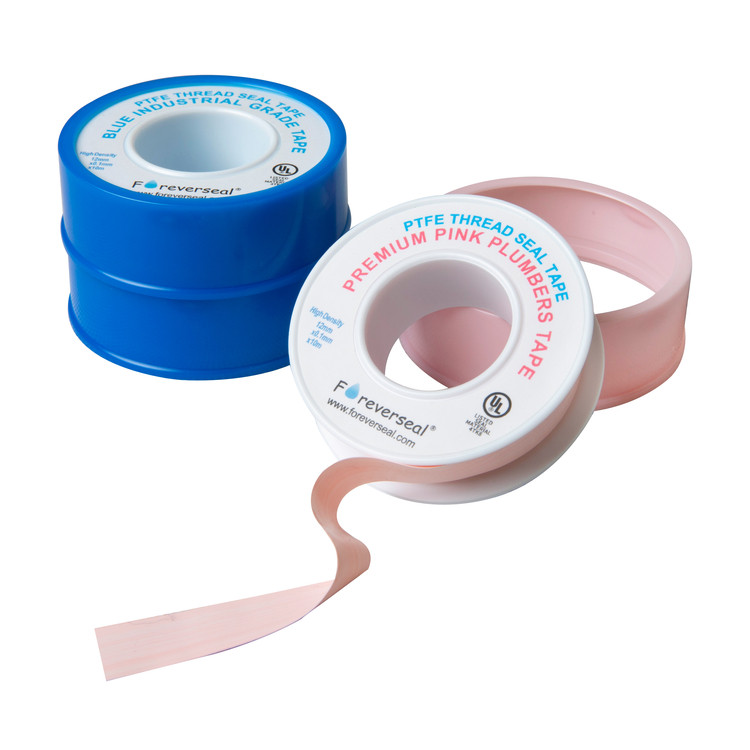
Industrial tape examples. A product photograph does not establish a temperature or pressure rating; confirm the exact model and service documentation.
What 85°C, 125°C and 250°C Mean in the Supplied Documents
The temperature points below come from the company's supplied documents. Each belongs to a defined product and assessment scope; they do not replace the broad TDS range or combine into one universal rating.
| Document and identified product | Temperature point or interval | Meaning and associated conditions |
|---|---|---|
| WRAS 2212523: DF201 white extruded PTFE tape | Water contact up to 85°C | Assessment of effects on water quality; not a joint mechanical-pressure approval |
| DVGW NG-5143DP0202 / 0203: identified 60 / 100 g/m² tapes | Fuel-gas scope −20°C to +125°C | Annex separates gas installations up to 5 bar, gas appliances up to 0.2 bar, and specified third-family LPG storage up to 20 bar |
| Same DVGW annex: hot-water scope | Up to 125°C | Hot-water conditions up to 7 bar; check the covered tape class and size |
| AGA 9389: FS12 / FS19 / FS25, Class III | −20°C to +250°C | Certificate lists 2,000 kPa under AS 4623-2008 for its covered products and scope |
Source: company-supplied WRAS, DVGW certificates and annexes, and AGA certificate copies. Confirm current status and the ordered product's correspondence to the certificate identifiers. Do not assume every Aqua, GasSafe or other marketing SKU is covered simply because it shares a color or material.
Why the Certificate Temperatures Differ
85°C addresses the stated water-contact assessment; it is not PTFE's melting point. 125°C is a boundary within the specified DVGW gas and hot-water scope. 250°C is listed in the AGA certificate for its identified products. These documents cover different questions and conditions, so their temperature values need not equal the 260°C upper value in the product TDS.
For example, the DVGW gas-installation scope cannot be stretched from 125°C to 260°C by referring to the resin's heat resistance. Nor may the specified LPG-storage pressure be used as a blanket pressure limit for all fuel-gas installations. Read each complete document and the applicable component limits together.
For a hot process or steam line, compare ForeverSeal Industrial PTFE thread seal tape against the actual medium and simultaneous conditions. A water-quality approval is not a steam qualification.
Low Temperature: Check the Whole Assembly
At low temperatures, the pipe, fitting and sealant can respond differently to contraction and loading. Include start-up, shutdown and return to ambient conditions when evaluating leakage. A room-temperature assembly test does not by itself demonstrate performance throughout a cryogenic cycle.
Oxygen service adds cleanliness and compatibility requirements to temperature selection. A tape with a broad low-temperature range is not automatically suitable for liquid oxygen, medical oxygen or another high-purity application.
Provide the minimum design temperature, fluid phase and pressure, component materials, cycling conditions and acceptance test when enquiring about ForeverSeal extreme-service sealing solutions. Do not assume a generic PTFE temperature rating qualifies an LNG or cryogenic joint.
Temperature and Pressure Must Be Evaluated Together
A maximum pressure and maximum temperature printed separately are not necessarily an approved simultaneous operating point. Ask for the applicable operating envelope, component derating information and supporting test conditions.
| Information needed | Why it matters |
|---|---|
| Exact tape model and applicable documents | Avoids transferring another product's limits |
| Thread standard, size and fitting material | Defines the connection being assessed |
| Normal and maximum pressure and temperature | Includes the actual simultaneous conditions |
| Transients and thermal cycles | Captures conditions beyond steady operation |
| Assembly and acceptance-test procedure | Defines how suitability will be verified |
There is no universal calculation that converts tape density into high-temperature pressure capability. The PTFE tape thickness and density guide explains what those specifications can tell a buyer.
What Xtreme Grade Changes—and What to Verify
The supplied Xtreme TDS positions the series for temperature extremes, vacuum and demanding industrial conditions. It lists 0.10 ± 0.01 mm thickness and 1.2–1.5 g/cm³ density, with the same −190°C to +260°C temperature range stated in the other series reviewed here.
Therefore, choosing Xtreme is not evidence of a higher upper temperature limit. Ask what documentation and evaluation apply to the exact joint and duty. A search for high temp thread tape should lead to those checks, rather than a promise based on the grade name.
Direction, coverage, tension and assembly still matter. See the PTFE tape installation guide and wrap-count and layer guidance before defining the installation procedure.
Discuss Your Temperature Requirements with ForeverSeal
Send your normal and design temperatures, pressure, medium, thread details and fitting materials. Include cycle frequency, any cleaning or sterilization conditions, and the approvals required by the project.
Contact ForeverSeal for PTFE tape temperature-selection support and technical documents. We can compare available product specifications and identify the information needed for your application evaluation.
Frequently Asked Questions
What is the PTFE max temperature for thread seal tape?
The reviewed ForeverSeal TDS state +260°C. The allowable temperature of your connection may be lower because of component, service or approval limits.
Can I use tape at 327°C because PTFE melts around that temperature?
No. A melting point is not an operating limit or proof of sealing performance. It does not extend the finished tape's documented service range.
Does higher density increase the PTFE temperature limit?
Not automatically. The reviewed Xtreme and Industrial TDS have different densities but state the same broad temperature range.
Can white PTFE tape be used on steam?
Color does not establish steam suitability. Confirm the exact product, steam conditions, component ratings and assembly requirements.