What Is PTFE? Material Properties, Resin Brands & Uses
- Share
- Issue Time
- Sep 15,2026
Summary
Learn what Teflon is, how it differs from PTFE, and how ForeverSeal turns PTFE into application-specific thread seal tape.
What Is PTFE? Material Properties, Resin Brands & Uses
Direct answer
PTFE is polytetrafluoroethylene, a fluoropolymer used in sealing, insulation and low-friction components. Resin brands identify suppliers or product families, while the exact grade and processing route determine suitability. For thread seal tape, compare paste-extrusion suitability, finished dimensions, mechanical properties and service documentation rather than assuming that an international brand or a familiar material name guarantees better sealing performance.
 | By Liu Yingbao Engineer · 20 years experience in PTFE line |
That distinction matters beyond terminology. A nonstick coating, a pipe-sealing tape and a machined component can involve PTFE yet behave differently because their formulations, structures and service conditions differ.
At ForeverSeal, the practical question is how to turn material properties into a specified sealing product. Explore the ForeverSeal PTFE product range, then use this guide to understand the material behind the roll.
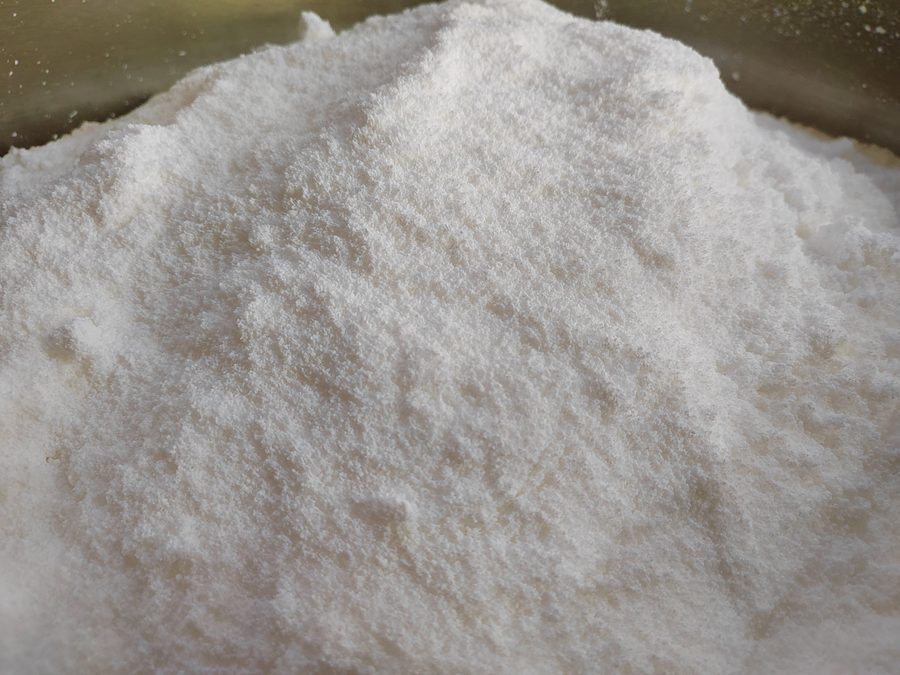
PTFE powder from the company raw-material image library. Appearance alone does not identify resin grade or confirm processing suitability.
1. What Is PTFE Made Of? Polymer Chemistry
For PTFE specifically, the repeating polymer unit is –CF₂–CF₂–, commonly written (C₂F₄)n. A long carbon backbone carries fluorine atoms around it.
Strong carbon–fluorine bonds and the fluorinated structure help explain its chemical stability. Its surface characteristics also contribute to low friction and poor adhesion. Those properties are connected, but they are not a guarantee of identical behavior in every product.
A useful relationship is:
Polymer chemistry → processing and structure → finished-product properties → application suitability.
For example, resin made into a conformable, unsintered thread seal tape has a different structure and role from resin processed into a dense machined part. The polymer name alone does not tell you which product belongs in a pipe joint.
2. Chinese and International PTFE Resin Brands: A Buyer’s Reference
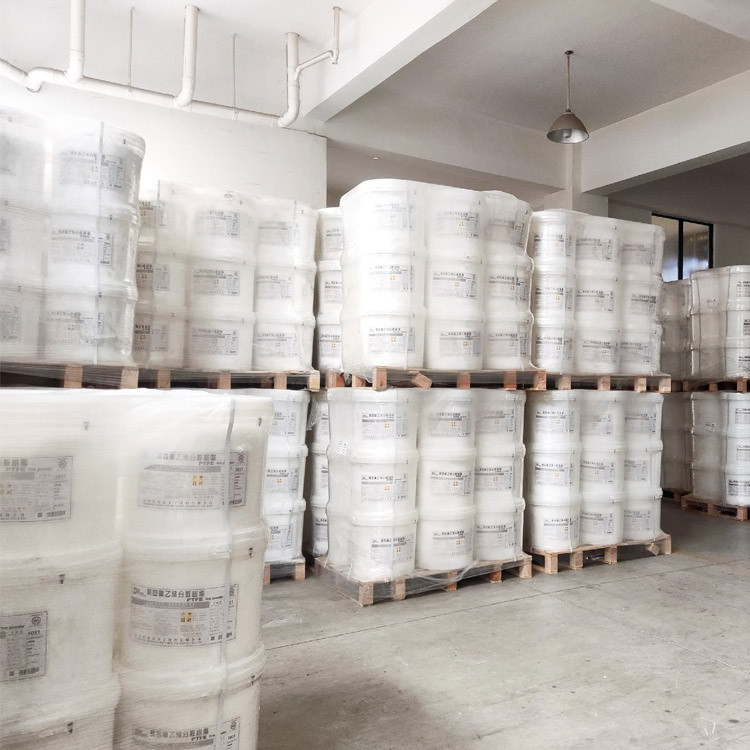
Raw-material drums stored on pallets. Confirm resin grade and batch traceability for each specified product.
Several manufacturers supply PTFE resins, often in multiple forms and many grades. The following is a reference list, not a ranking or an approved-supplier list for ForeverSeal.
| Supplier / family | Market reference | What to verify for a tape project |
|---|---|---|
| Juhua | Chinese producer; PTFE products are listed through its digital marketplace, including Zhejiang Jusheng Fluorochemical | Exact grade, resin form, processing recommendation and batch documentation |
| Dongyue | Chinese fluoropolymer producer with PTFE in its published portfolio | Whether the selected grade supports the intended extrusion and stretching process |
| AGC — Fluon® PTFE | International resin family; its CD fine powders are described for paste extrusion, including tapes and stretched films | Specific CD grade, extrusion conditions and the properties required after processing |
| Daikin — POLYFLON PTFE | International resin family offered in fine powder, molding powder and dispersion forms | Select the appropriate form and grade; a coating dispersion is not a substitute for a tape-processing powder |
Brand names here identify industry reference suppliers. They do not establish ForeverSeal’s purchasing relationships, branded-resin content, authorization or endorsement. Actual sourcing and grade traceability must be confirmed for a particular order.
Why Resin Form Matters More Than a Brand-Only Comparison
A supplier can offer several materials called PTFE that are intended for different processes.
| Resin form | Typical processing or function | Implication for tape selection |
|---|---|---|
| Fine powder / coagulated dispersion powder | Paste extrusion into suitable tapes, tubes and stretched structures, depending on grade | A relevant starting point for evaluating thread seal tape manufacture |
| Granular / molding powder | Compression molding or ram extrusion for suitable grades | Not interchangeable with fine powder merely because both are PTFE |
| Aqueous dispersion | Coating or impregnation applications | A liquid formulation, not the same as dry fine powder |
| Micropowder | Additive functions in selected formulations | Not a default substitute for structural tape resin |
The phrase “dispersion” deserves attention: dry coagulated dispersion powder and aqueous dispersion are different supply forms. Ask for the exact product code and TDS rather than buying by an abbreviated description.
How ForeverSeal Should Evaluate a Resin Change
For a thread seal tape project, a useful evaluation links the incoming resin grade and lot to trial processing, the resulting strip and the intended service. Compare extrusion stability, thickness and width variation, tensile strength and elongation using an agreed method; then assess the finished product against the application requirements.
A resin change should not inherit the previous tape’s certificates automatically. Check the approval conditions and any notification or retesting requirements. This is a more defensible purchasing approach than assuming imported resin is always better or that domestic grades are interchangeable.
Discuss the required finished-tape properties with ForeverSeal PTFE material development and testing support.
3. Polytetrafluoroethylene Properties: Benefits and Engineering Limits
Low Friction Helps Assembly, but Does Not Set Tightening Torque
PTFE is widely used where low friction is valuable. In thread sealing, it can reduce resistance during assembly while the tape conforms to spaces between threads.
This is not an instruction to tighten harder. Reduced friction changes the relationship between turning effort and loading. Follow the fitting manufacturer's assembly procedure, especially with plastic fittings and mixed materials.
Nor does a nonstick surface prevent tape from sealing. The seal is formed by confinement and compression within an appropriate threaded joint, rather than adhesive curing.
Heat Resistance: Separate Melting Point from Working Temperature
| Polymer | Published melting point | What the figure tells you |
|---|---|---|
| PTFE | 327°C / 621°F | A material transition value, not an allowable joint temperature |
| FEP | 260°C / 500°F | A different polymer's transition value |
| PFA | 306°C / 582°F | A separate material value, not a PTFE tape rating |
Source: Chemours product selection guide. These are typical reference values, not a performance ranking of finished products.
Some PTFE material references identify 260°C / 500°F as an upper continuous-use temperature. A finished seal can have a substantially narrower permitted envelope because pressure, deformation, media and certification conditions also matter. Source: Chemours fluoropolymer material brochure
For example, ForeverSeal's local Aqua TDS lists a broad material/product temperature range, while WRAS Material Approval 2212523 specifically identifies DF201 white tape for water contact up to 85°C. The WRAS document concerns effects on water quality; it is not a mechanical pressure approval. The ordered SKU must be matched to the covered material before using that reference.
The engineering lesson is to use the applicable product and service limit, not the largest temperature printed anywhere in the document set.
Broad Chemical Resistance Does Not Mean Universal Compatibility
PTFE resists many commonly encountered chemicals. However, Daikin identifies exceptions including molten alkali metals, chlorine trifluoride and elemental fluorine under severe temperature and pressure conditions. Source: Daikin PTFE product stewardship summary
Compatibility selection should identify the chemical, concentration, temperature and pressure. A chemically resistant polymer also does not establish that a complete threaded connection is leak-tight, clean enough or suitable for a particular gas.
Deformation Can Help Sealing—and Also Needs Control
Tape must conform to the joint to perform its job. Yet a specification also needs to account for deformation under sustained load and temperature. A dense structural part and a soft thread-sealing strip should not be evaluated by the same assumptions.
For a tape buyer, thickness, density, tensile properties and application testing are more useful than a claim that the material is simply “strong” or “heat resistant.” These measurements describe different aspects of performance and should be considered together.
4. PTFE Product Forms: Tape, Film, Coating and Machined Parts
The same broad material family supports many product forms. Their properties should not be transferred automatically from one form to another.
| Form | Typical function | Key distinction |
|---|---|---|
| Unsintered PTFE thread seal tape | Conforms within suitable threaded joints | Not an external pipe-repair wrap or adhesive tape |
| PTFE film or sheet | Insulation, barriers or component fabrication | Structure, thickness and processing route matter |
| Expanded PTFE | Porous structures for selected sealing or membrane applications | Porosity changes function; not equivalent to dense PTFE |
| Fluoropolymer coating | Surface release, friction or protection | Coating formulation and substrate are part of the system |
| Machined PTFE component | Seals, seats and other engineered parts | Dimensions, loading and deformation govern selection |
These are industry examples, not a claim that ForeverSeal manufactures every form listed. For the current product scope and development options, review ForeverSeal PTFE material research and technology.
5. What Is PTFE Used For in Industry and Plumbing?
PTFE and related fluoropolymers appear in cookware coatings, electrical insulation, chemical-handling components and sealing systems. The common thread is a useful combination of surface, thermal and chemical properties; the specifications differ by application.
In plumbing, PTFE tape helps seal connections designed to seal at the threads. It does not replace a washer, O-ring, compression ferrule or flare seat. A material suitable for one type of connection is not automatically suitable for another.
In chemical equipment, resistance to the actual fluid is essential. In oxygen or high-purity gas equipment, compatibility and cleanliness require separate evidence. “PTFE” on the label answers the material question, not all of these application questions.
6. How ForeverSeal Turns Material Properties into a Tape Specification
ForeverSeal's Aqua and Industrial TDS files demonstrate why a material name is only the starting point.
Selected Aqua models list 0.10 mm thickness with density values of 0.4 g/cm³ or 0.7 g/cm³. The Industrial TDS lists 0.10 mm thickness and nominal density 1.0 g/cm³. These are manufacturer specifications for particular models—not universal definitions of water or industrial grades.
At equal thickness, changing density changes the calculated material mass per area:
| Model example from local TDS | Density | Thickness | Calculated mass per area |
|---|---|---|---|
| Aqua AQ-W12-T10-D4 | 0.4 g/cm³ | 0.10 mm | 40 g/m² |
| Aqua Pro AQP-W12-T10-D7 | 0.7 g/cm³ | 0.10 mm | 70 g/m² |
| Industrial ID-W12-T10-D10 | 1.0 g/cm³ | 0.10 mm | 100 g/m² |
Calculation: density × thickness in mm × 1,000 = g/m². These calculated values are not measured leakage results, approval classifications or evidence that one model seals proportionally better.
Sources: ForeverSeal Aqua and Industrial technical data sheets supplied in the company material library. Confirm the current agreed specification for the order; this comparison does not map the models to a certificate automatically.
This is where manufacturing control becomes relevant. A buyer should ask whether the supplied tape consistently meets its agreed dimensions, mechanical properties and application requirements. ForeverSeal's published R&D approach describes small-batch validation and evaluation of mechanical behavior and dimensional stability. Learn more about ForeverSeal PTFE testing and material development.
7. Is PTFE Safe? Keep the Application in View
Safety should be assessed for a defined product and use, rather than answered by the brand name alone.
For cookware, Germany's Federal Institute for Risk Assessment reports that adverse health effects are not expected when PTFE-coated utensils are used as intended. It warns against strong overheating of empty cookware, including temperatures around 360°C and above, where hazardous gases can form. This cookware guidance is not a safe operating limit for industrial tape, and it does not mean every exposure below that temperature is acceptable. Source: BfR PTFE cookware guidance
PTFE is also different from PFOA. Under broad PFAS classifications, PTFE is a polymeric PFAS; a “PFOA-free” statement does not mean “PFAS-free.” Do not make either product-specific claim without the appropriate documentation. Source: OECD fluoropolymer life-cycle synthesis report
For thread seal tape, ask about the finished formulation, SDS, operating conditions and service-specific evidence. Drinking-water documentation does not establish oxygen compatibility, and a material temperature figure is not a substitute for system evaluation. Review ForeverSeal's approach to PTFE material safety and responsible manufacturing and request documents relevant to your actual product.
8. Discuss Your PTFE Material Requirements with ForeverSeal
A useful specification starts with the application: the medium, connection design, operating conditions and required documentation. The next step is selecting a product form and measurable properties that fit those requirements.
Share your tape dimensions, target market, quantity and any special material or packaging needs. ForeverSeal can discuss its available PTFE products, current technical data and evaluation options for your project.
9. FAQs About PTFE Materials and Resins
Is PTFE a plastic?
Yes. PTFE is a fluoropolymer plastic. Resin brand names identify commercial product families rather than changing this material classification.
Does the resin brand determine tape quality?
No. Grade selection, processing consistency, finished specifications and service-specific evidence all matter. Compare like-for-like products rather than brand names alone.
What temperature can PTFE handle?
There is no single answer for every finished product. PTFE has a typical melting point around 327°C, but usable temperature depends on the grade, product form, loading, fluid and applicable approval. Melting point is not a design limit.
Why is PTFE used in thread seal tape?
Its conformability, low friction and chemical resistance are useful in suitable threaded joints. Final suitability still depends on tape specifications, the connection and service conditions.
Does PTFE need an adhesive to seal threads?
Conventional PTFE thread seal tape seals through compression and confinement in a suitable joint. It does not rely on a pressure-sensitive adhesive or a curing reaction.
Does “pure PTFE” guarantee suitability for drinking water or oxygen?
No. Material composition alone does not prove approval, cleanliness or compatibility under the intended conditions. Check the exact product and the scope of the supporting documents.